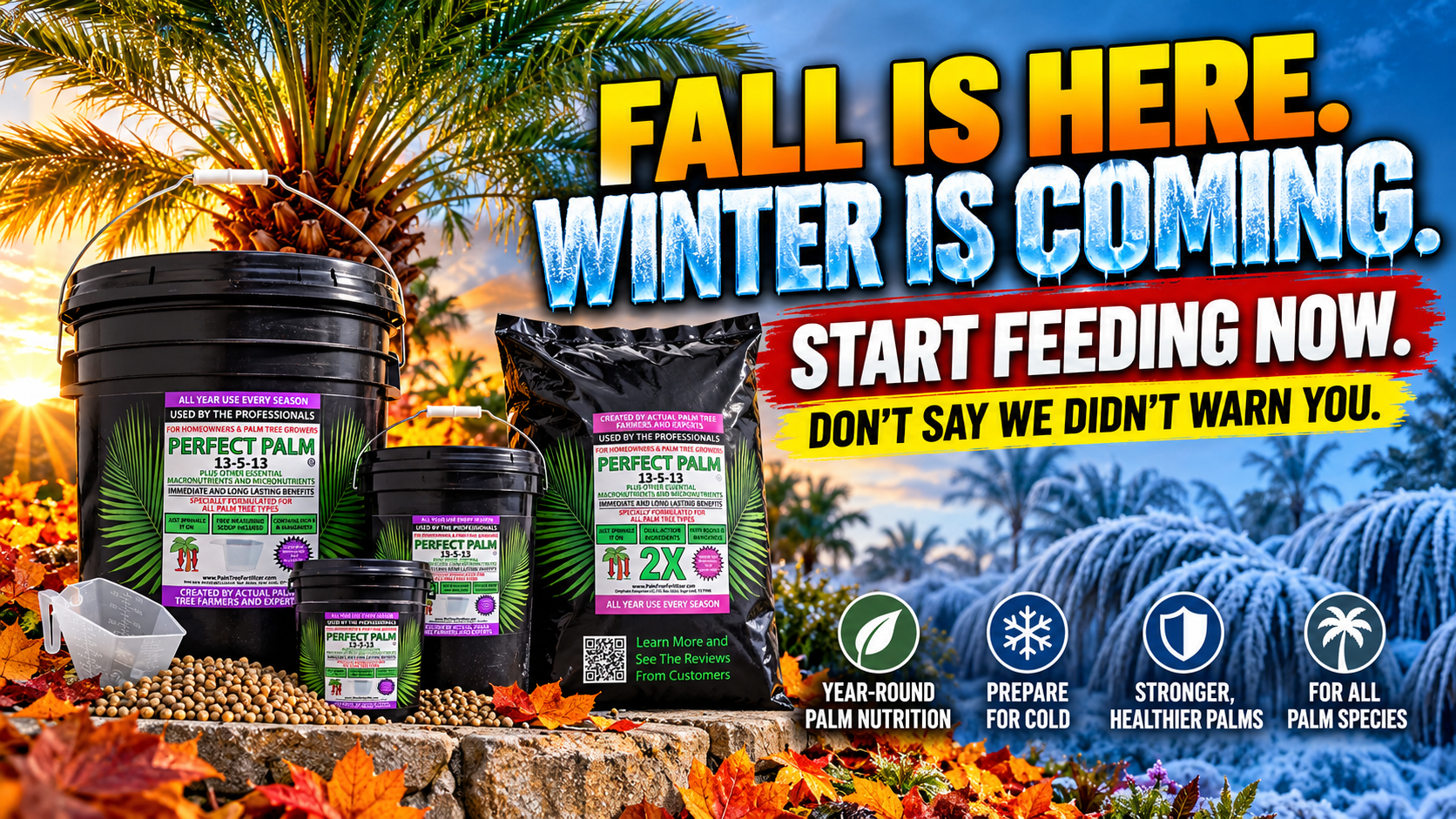
Florida palm winter preparation is especially important in 2026 for homeowners and landscapers who replaced freeze-damaged trees or are still helping surviving palms recover.
Florida’s historic freezes earlier in 2026 left countless landscapes with severely damaged palms, expensive replacements, and months of recovery ahead. Homeowners, HOAs, resorts, and landscape professionals spent the spring and summer replacing palms or trying to restore those that survived.
Now, as another winter approaches, there’s an important question:
Are those palms truly established and healthy enough to face another round of cold stress?
At Perfect Palm® Fertilizer, we believe fall preparation should focus on stabilization, root establishment, and balanced nutrition rather than forcing excessive new growth.
Our six-week spoon-feeding program was developed by experienced palm growers to deliver smaller, measured quantities of essential nutrients instead of relying on large, infrequent seasonal fertilizer applications.
The next freeze warning is not the time to begin preparing your palms. That preparation should already be underway.
You Replaced Your Freeze-Damaged Palms. But Have They Established?
Mature Canary Island Palm Installation Transplant Care Before Winter
A palm planted in March, April, May, or even June may have enjoyed months of favorable growing weather. It may have opened new leaves, developed a beautiful canopy, and appeared to recover from transplanting.
But has it established enough roots?
This is particularly important for large landscape palms, whose root systems may have been substantially disturbed during harvesting and installation.
Depending on the species, planting method, soil conditions, irrigation, and existing root development, establishment can take many months.
A green canopy is encouraging, but it does not necessarily prove that a palm has developed an extensive, functional root system.
That means two palms planted on the same day may establish at very different rates.
And a newly planted palm entering winter with limited root development may have less capacity to tolerate additional environmental stress.
Now is the time to evaluate those expensive replacements, not simply assume they are established because they survived the summer.
What About the Palms That Survived the 2026 Freeze?
Florida palm winter preparation illustrated by snow-covered palm trees exposed to freezing temperatures and potential cold damage.
Not every damaged palm needed replacement.
Across Florida, many palms that initially appeared severely injured began producing new spears and opening fresh foliage as warmer weather returned.
Some recovered remarkably well. Others still display sparse canopies, yellowing foliage, or slower-than-expected growth.
Survival and complete recovery are not the same thing.
A palm that lost much of its canopy must restore its photosynthetic capacity while maintaining its existing tissues and root system.
That process depends on adequate water, favorable growing conditions, and essential nutrients.
Following the historic freeze, we published several educational videos explaining palm recovery, proper trimming, nutritional management, and the differences between traditional fertilizers and modern feeding programs.
Our freeze-recovery video series attracted substantial attention, with one video surpassing 100,000 views.
In this video, we compare fertilizer spikes, liquid fertilizers, long-term controlled-release products, and our six-week feeding methodology. We also demonstrate concerns associated with some long-lasting polymer-coated fertilizer granules.
Surviving last winter was the first challenge. Restoring long-term health before the next one is the priority now.
Fall Fertilization Should Focus on Stabilization, Not Forcing Growth
Fall and Pre-Winter Palm Care & Fertilization
Traditional palm fertilization programs often rely on relatively large applications several months apart.
Other recommendations suggest stopping fertilization altogether as winter approaches.
Both approaches can overlook important differences in how fertilizers are formulated, applied, and released into the soil.
A heavy application of readily available nitrogen is not equivalent to a smaller, measured feeding containing controlled-release nutrients.
As temperatures decline, palm growth and nutrient uptake can slow. Large nitrogen applications under unfavorable conditions may be inefficient and poorly timed.
But nitrogen remains essential for palm health, and a palm does not automatically stop needing nutrients simply because the calendar changes.
The goal is not to force rapid growth before winter. It is to maintain adequate nutrition while the palm is still actively growing.
This is why Perfect Palm® was developed around a different feeding philosophy.
Our fertilizer was designed to provide balanced nutrition through smaller, repeated applications rather than relying on one heavy seasonal feeding.
This approach is particularly relevant for palms transitioning between growing conditions, including newly installed palms, container-grown palms, and established landscapes.
Instead of requiring one large application to supply nutrients for several months, the six-week program allows nutrient delivery to be managed in smaller increments.
Our formula includes XCU® controlled-release nitrogen technology, along with additional nutrient sources selected to support palm nutrition under varied growing conditions.
You can see exactly what goes into the product here:
The objective is consistent nutritional management, not forcing excessive growth.
Applications should always follow the label and account for actual growing conditions, including periods when cold temperatures limit nutrient uptake.
Potassium, Magnesium, and Micronutrients Matter Before Winter
Nitrogen gets much of the attention in fertilizer discussions, but healthy palms require considerably more than nitrogen alone.
Several nutrients are especially important for normal physiological function and maintaining healthy foliage.
Potassium (K) plays an essential role in water regulation, enzyme activity, and numerous plant metabolic processes. Potassium deficiency is also a common nutritional problem affecting Florida landscape palms.
Magnesium (Mg) is central to chlorophyll production and photosynthesis. Deficiencies can contribute to yellowing foliage and reduced photosynthetic capacity.
Manganese (Mn) supports photosynthesis and normal development of new leaves. Severe deficiencies can cause distorted or necrotic emerging growth.
Boron (B) is required in very small amounts for normal growing-point and tissue development. Both deficiency and excess can cause problems, making appropriate application rates especially important.
Iron (Fe) supports chlorophyll formation and numerous metabolic processes. Iron deficiency symptoms may also be associated with poor root conditions rather than inadequate iron in the soil.
Perfect Palm® incorporates these nutrients into its balanced formulation, including multiple nutrient sources intended to support availability under different soil conditions.
It’s important to distinguish adequate nutrition from excessive nutrition.
Applying extra potassium, magnesium, or micronutrients beyond a palm’s actual requirements does not guarantee improved freeze tolerance.
Our goal is to help prevent avoidable nutritional deficiencies from becoming an additional source of stress before winter.
How Much Fertilizer Should You Apply Before Winter?
There is no need to guess how many pounds of fertilizer to apply or assume every palm should receive the same quantity.
This is particularly helpful for homeowners caring for newly installed palms of different sizes.
What About University Recommendations to Stop Fertilizing in Winter?
University Extension guidance commonly cautions against fertilizing cold-damaged plants to stimulate growth when additional freezing weather is possible.
That advice has an important purpose.
Applying large amounts of fertilizer to force tender new growth immediately before another freeze is not a sound winter preparation strategy.
However, it is also important to recognize that fertilizer products differ substantially in nutrient sources, release rates, quantities, and application schedules.
A large, rapidly available nitrogen application is not the same as a smaller, measured feeding program.
Nor are all Florida palms growing under identical winter conditions. South Florida, Central Florida, and North Florida experience different temperatures and growing seasons.
A palm’s actual growing conditions should influence fertilization decisions.
Perfect Palm’s approach is to address nutritional needs before severe cold arrives, while palms are still actively growing, rather than waiting until a freeze has already occurred.
During periods of freezing weather, frozen or saturated soil, or severely compromised root function, fertilization may need to be postponed regardless of the product used.
For a deeper examination of traditional Florida fertilizer recommendations and the differences among nutrient-release technologies, read:
Developed by Palm Growers With Decades of Experience
Farmers that created Perfect Palm fertilizer
Perfect Palm® wasn’t developed simply by choosing a fertilizer analysis from a catalog.
Its formulation and feeding philosophy emerged from decades of growing, installing, transplanting, and managing palms under real-world conditions.
Our sister company, Palm Professionals Tropical Nursery, grows and manages nearly 100 species of palms, ranging from seedlings and container-grown specimens to large field-grown landscape palms.
That experience includes transplant establishment, nutritional deficiencies, root development, cold injury, and post-freeze recovery.
Working with such a wide range of palms has helped shape our understanding of the challenges facing growers and property owners.
It also inspired our efforts to re-examine traditional fertilizer application schedules.
Our 2026 Research Challenges Traditional Heavy Fertilization
In January 2026, we published an applied research paper examining modern palm fertilization strategies and comparing frequent, low-dose nutrient delivery with traditional infrequent, heavy applications.
Re-evaluating Palm Fertilization Strategies: Long-Term Field Evidence Supporting Frequent Low-Dose Nutrient Delivery Over Infrequent High-Dose Applications
The research draws on long-term field observations involving approximately 100 palm species across nursery production, residential landscapes, and commercial projects.
It examines multiple fertilization methods, including:
Traditional extended-duration controlled-release fertilizers
The observations favor smaller, more frequent applications for maintaining nutrient availability and reducing recurring deficiency symptoms compared with infrequent heavy feeding.
The paper also discusses how nutrient delivery timing and release characteristics can affect plant response and the potential for nutrient loss.
Our central finding is that fertilizer application frequency and nutrient-delivery stability deserve as much attention as the fertilizer’s N-P-K ratio.
This work represents applied field research rather than a randomized, controlled fertilizer trial. Further independent comparisons would help quantify the differences under specific growing conditions.
We also published a separate 2026 paper specifically examining nutrient continuity during cold weather:
Rethinking Seasonal Fertilization: How Nutrient Continuity Supports Winter Physiology, Cold Tolerance, and Recovery in Palms
That publication examines observations of palms maintained under continuous low-dose nutrition during winter conditions and discusses their nutrient uptake and recovery after cold exposure.
Together, these publications provide additional context for why we developed Perfect Palm’s six-week spoon-feeding program.
Florida Palm Winter Preparation: Is Your Palm Ready
Before cooler weather arrives, take a closer look at your palms, particularly those planted or damaged earlier in 2026.
1. Examine the newest growth. Is the newest spear developing normally? Are emerging leaves healthy, or do they show unusual yellowing, distortion, or necrosis?
2. Evaluate root establishment. Is the palm stable and showing signs of continued growth? Remember that above-ground appearance alone cannot confirm complete root establishment.
3. Check irrigation and drainage. Newly planted palms need appropriate moisture, but prolonged saturation can damage roots and interfere with nutrient uptake.
4. Look for nutritional deficiencies. Yellowing, discoloration, or abnormal growth may indicate nutrient problems, although disease, root damage, salinity, and irrigation issues can produce similar symptoms.
5. Review your fertilization program. Are you relying on occasional heavy applications, or are you following a measured spoon-feeding schedule appropriate for the palm and conditions?
6. Prepare before freezing temperatures arrive. Nutritional deficiencies and poor establishment cannot be corrected overnight when a freeze warning is issued.
If your palms are actively growing and require supplemental nutrition, fall provides an opportunity to address those needs before conditions become less favorable.
Because once another freeze is forecast, there may be little time left to correct months of nutritional deficiency or incomplete root establishment.
Your palms survived 2026. Give them the best opportunity to enter the next winter healthy, established, and properly nourished.
What Is the Best Palm Fertilizer for Florida Entering 2027?
If you grow palms in Florida, you’ve probably heard some version of the same advice: “You have to use 8-2-12 with 4% magnesium. That’s the UF/IFAS recommended palm fertilizer.”
Over the years, that recommendation has sometimes been simplified even further into the idea that if a fertilizer isn’t 8-2-12, it shouldn’t be used on a Florida palm at all. But when you actually read the University of Florida research behind the recommendation, the story is considerably more complicated—and much more interesting.
UF/IFAS has supported properly formulated 8-2-12 + 4Mg as a maintenance fertilizer for landscape palms in Florida under a particular nutrient-delivery strategy. However, UF/IFAS literature also discusses 8-0-12 + 4Mg for landscape palms, higher-nitrogen fertilizers such as 18-6-12 for container-grown palms, different considerations for newly transplanted palms, and specialized corrective programs for severe nutrient deficiencies.
Even Dr. Timothy K. Broschat, the University of Florida researcher responsible for much of the work behind Florida’s traditional palm fertilizer recommendations, published an article titled “Not All Landscape Palm Fertilizers Are Created Equal.” His research makes an important point that often gets lost when people focus exclusively on N-P-K numbers: two bags can both say 8-2-12-4Mg and still contain different nutrient sources that behave very differently after application.
As we approach 2027, perhaps the most useful question is no longer simply, “Is this fertilizer 8-2-12?” We should also be asking what nutrient sources are being used, how quickly those nutrients become available, how much fertilizer is applied at one time, how frequently it is applied, what soil or growing medium the palm is growing in, and whether the palm is in a container, newly installed, established in the landscape, or recovering from nutritional stress.
Most importantly, we should ask whether modern palm fertilizer programs should be evaluated using everything we know today or exclusively by a maintenance strategy developed around research, fertilizer technologies, and application intervals dating largely from decades ago.
Where Did Florida’s 8-2-12 Palm Fertilizer Recommendation Come From?
To understand Florida’s traditional 8-2-12 recommendation, we first need to understand the problem researchers were trying to solve.
Many Florida soils have relatively low nutrient-holding capacity. Heavy rainfall and irrigation can move soluble nutrients through the root zone, and different nutrients don’t necessarily remain available at the same rate. A fertilizer may supply nitrogen, potassium, magnesium, and micronutrients in the desired proportions when it is applied, but the nutrients remaining available to the palm several weeks later may no longer exist in those same proportions.
This was an important nutrient-management problem.
UF/IFAS’s publication “Fertilization of Field-Grown and Landscape Palms in Florida” explains that slow-release nutrient sources are important for maintaining nutrient availability during the roughly two-to-three-month interval between fertilizer applications. The publication describes the traditional 8-2-12 + 4Mg formulation as a maintenance fertilizer designed around that type of feeding interval.
That historical context matters because 8-2-12 was never simply four magical numbers. It was part of a nutrient-delivery system.
The objective was to apply fertilizer, control the release of important nutrients, keep those nutrients available despite rainfall and irrigation, maintain an appropriate nutritional balance, and then fertilize again approximately three months later.
That is considerably more sophisticated than simply saying, “Palms need 8-2-12.”
How Old Is the Research Behind Florida’s Traditional Palm Fertilizer Recommendation?
Older research does not mean bad research. Good science doesn’t suddenly become worthless because it reaches a certain age. However, the age of the research does matter when a decades-old recommendation is presented as though it should permanently end discussion about newer fertilizer technologies and different nutrient-delivery strategies.
Some of the research contributing to Florida’s traditional palm nutrition recommendations dates back decades. Broschat published research involving soluble and controlled-release potassium fertilizers in 1996 and controlled-release and soluble magnesium fertilizers in 1997. Additional work involving iron sources appeared in 2005, controlled-release nutrient behavior in 2007, boron research in 2008, and the widely cited Palm Nutrition and Fertilization paper in 2009. Additional landscape research followed, including later work involving 8-0-12 formulations.
It is now 2026, approaching 2027. Some of the foundational controlled-release nutrient research behind the traditional recommendation is approximately 30 years old.
That doesn’t make those findings irrelevant. They helped establish important principles involving nutrient balance, leaching, nutrient deficiencies, and nutrient-release characteristics. Modern palm nutrition should build upon those discoveries.
But fertilizer manufacturing has continued to change. Controlled-release technologies have evolved. Environmental research has expanded. Nutrient-management strategies have changed, and our understanding of the environmental fate of certain fertilizer materials has advanced considerably.
We can also ask questions today that weren’t necessarily the questions being investigated in the 1990s: What happens if, instead of designing a relatively large fertilizer application to bridge approximately three months, we reduce the amount applied at one time and return with another measured feeding approximately six weeks later?
That doesn’t make the older research wrong. It means we’re asking a different question.
Three-Month Feeding Versus Six-Week Feeding
The feeding interval is one of the most overlooked parts of this discussion.
UF/IFAS describes the traditional landscape maintenance fertilizer around an approximately three-month application schedule. Broschat’s later publication, “Not All Landscape Palm Fertilizers Are Created Equal,” even includes fertilizer-source information based on three-month release characteristics.
This is important because a fertilizer formulation and its application schedule should be considered together. If a fertilizer application is expected to carry a palm for approximately three months, nutrient sources must be selected with that period in mind.
Perfect Palm® approaches nutrient delivery differently. Instead of attempting to duplicate a three-month feeding program, Perfect Palm® uses smaller measured applications approximately every six weeks. We often describe this as a spoon-feeding approach: instead of placing a larger amount of fertilizer into the environment and asking that application to continue supplying the palm for several months, we intentionally return sooner with another smaller measured feeding.
You can learn more about the Perfect Palm® feeding philosophy here:
The important point is that a six-week feeding program and a three-month feeding program are different nutrient-delivery systems. Comparing only the numbers printed on the front of the fertilizer bag ignores the amount being applied, the nutrient sources, and the interval between applications.
Are All 8-2-12 Palm Fertilizers the Same?
No, and UF/IFAS itself makes this point.
Broschat’s “Not All Landscape Palm Fertilizers Are Created Equal” explains that simply having an analysis of 8-2-12-4Mg does not necessarily mean two fertilizers will perform the same way. Nutrient sources matter because one source may be highly soluble while another releases more slowly. Different magnesium, potassium, nitrogen, micronutrient, and coating technologies can behave differently after application.
The guaranteed analysis tells us how much of a nutrient is guaranteed in the fertilizer. It does not, by itself, tell the entire story of how those nutrients will behave once the product is applied.
This is why evaluating palm fertilizer exclusively by the three numbers on the front of the bag can be misleading.
We explain this in greater detail on our How to Read a Palm Fertilizer Label page:
Magnesium Is a Good Example of Why the Numbers Aren’t Enough
Magnesium provides an excellent example.
A fertilizer label may identify magnesium sulfate as a nutrient source, but different magnesium-containing materials can have different solubility and release characteristics. Kieserite, for example, is magnesium sulfate monohydrate and behaves differently from highly soluble magnesium sulfate sources such as Epsom salts.
Both supply magnesium, but that doesn’t mean they necessarily make magnesium available in exactly the same manner or over the same period.
That distinction becomes especially important when a fertilizer program is being engineered around maintaining nutrient availability for months between applications.
The same principle applies more broadly: fertilizer formulation involves more than N-P-K numbers.
Does UF/IFAS Recommend Only 8-2-12 for Palms?
No.
UF/IFAS also recognizes 8-0-12 + 4Mg as an acceptable landscape formulation under appropriate conditions. That alone demonstrates that 8-2-12 isn’t an immutable biological requirement for palms.
The distinction becomes even more obvious when we look at container-grown palms.
UF/IFAS’s “Nutrition and Fertilization of Palms in Containers” explains that palms growing in containers experience a different nutritional environment from palms growing in native Florida landscape soils. Container substrates can have very different nutrient-holding characteristics, and microorganisms decomposing organic components of potting media can compete with palms for nitrogen.
The UF/IFAS publication specifically discusses high-nitrogen fertilizers such as 18-6-12 as working well for container-grown palms.
Consider what that means. A traditional Florida landscape recommendation may contain 8% nitrogen, while UF/IFAS discusses an 18% nitrogen fertilizer for palms in containers.
The palm didn’t suddenly become a different kind of plant because somebody put it into a pot. The growing environment changed. The substrate changed, nutrient retention changed, and the nutritional strategy changed accordingly.
UF/IFAS even discusses fertilizer application when potting up palms, further demonstrating that container production and landscape maintenance aren’t treated as identical nutritional situations.
This is an important principle: the same palm can require a different nutritional strategy when its growing environment changes.
So Why Is Perfect Palm® 13-5-13?
Perfect Palm® has a guaranteed analysis of 13-5-13 + 3Mg.
People familiar with Florida’s traditional landscape recommendation occasionally see 13% nitrogen and immediately assume that it must be too much nitrogen for a palm. But UF/IFAS’s own literature demonstrates why that conclusion is too simplistic.
Its traditional landscape example contains 8% nitrogen, while its container guidance discusses fertilizer containing 18% nitrogen. Interestingly, 13 falls mathematically between those two numbers.
That observation does not prove that 13% nitrogen is ideal simply because it happens to sit between 8 and 18. That would be another oversimplification. What it does demonstrate is that 8% nitrogen is not a universal biological ceiling for palms.
Perfect Palm® was developed around a different overall feeding strategy: a balanced 13-5-13 + 3Mg formulation applied in smaller measured quantities approximately every six weeks. The fertilizer analysis, nutrient sources, amount applied, and feeding interval are intended to work as one system.
Learn more about the formulation and our approach here:
Maintenance Nutrition Is Not the Same as Nutritional Recovery
Another problem with reducing palm nutrition to one fertilizer analysis is that maintaining a healthy palm and correcting an existing nutritional problem aren’t necessarily the same job.
UF/IFAS recognizes this distinction as well. Severe potassium deficiency, for example, can require a specialized corrective strategy involving potassium and magnesium rather than simply applying more ordinary maintenance fertilizer. Some severe deficiencies can take a considerable amount of time to correct.
In other words, even the traditional research doesn’t treat every palm nutritional situation as identical. Landscape maintenance is one problem. Container production is another. Transplant establishment is another. Correcting a serious deficiency can be another.
Perfect Palm® was designed with a broader goal: to create a balanced nutritional platform that can be used through more stages of palm production, installation, establishment, maintenance, and nutritional recovery, with the amount adjusted appropriately for the palm and situation.
What About Newly Installed Palms?
The distinction continues when palms are transplanted.
UF/IFAS’s “Transplanting Palms in the Landscape” discusses different considerations depending upon how palms were produced before installation. Container-grown and field-grown palms don’t necessarily enter the landscape under identical conditions.
Again, the research itself is more nuanced than the simplified statement that every palm, at every stage, simply needs the same 8-2-12 treatment.
One of the design objectives behind Perfect Palm® was to reduce that complexity by creating a formulation and application system that can follow palms from container production into installation, establishment, and routine landscape feeding.
Controlled Research and Real-World Diversity Are Two Different Kinds of Evidence
This may be one of the most important distinctions in the entire discussion.
Controlled university research is extremely valuable because researchers intentionally limit variables. Controlling variables allows researchers to make much stronger conclusions about cause and effect.
However, that strength can also become a limitation when the results of a narrowly controlled experiment are later interpreted as though they establish a universal recommendation for every palm, soil, climate, and growing situation.
Consider the 2008 study by Broschat, Sandrock, Elliott, and Gilman that is frequently cited in discussions of Florida landscape fertilization. The researchers conducted three experiments at two Florida locations on highly leached sandy soils. In that particular fertilizer-comparison study, the palm species evaluated was Areca palm, Dypsis lutescens, along with St. Augustinegrass and several non-palm ornamental plants.
That research provided valuable information about what happened under those experimental conditions. But it is different from demonstrating that one fertilizer formulation or application interval is necessarily optimum for dozens or hundreds of palm species growing in dramatically different soils, climates, and production systems.
That doesn’t invalidate the study. It defines the scope of what the study actually tested.
This distinction becomes especially important when the results of controlled Florida research are transformed into the much broader statement that every palm should only be fertilized with 8-2-12.
Perfect Palm® Has Faced a Very Different Kind of Test
Perfect Palm® has certainly been developed, observed, and used extensively within our own nursery operations, but that represents only part of its history.
The fertilizer left our control years ago.
It has been purchased and used independently by commercial palm growers, nurseries, landscape professionals, arborists, serious palm collectors, experienced hobbyists, homeowners, and complete beginners. It has also been used in substantially different climates and growing environments.
Perfect Palm® has been used on Areca palms in Panama, and customers and growers have used the product in Florida, Texas, Louisiana, Mississippi, Alabama, Arizona, California, Hawaii, Panama, Curaçao, Barbados, the Bahamas, the U.S. Virgin Islands, Turks and Caicos, Bermuda, Saint Kitts, and other locations throughout the Caribbean and beyond.
This geographic diversity matters because these palms aren’t all growing in one type of Florida sand. They aren’t receiving the same rainfall, irrigation water, temperatures, or management. They aren’t all the same species or age, and they aren’t all being cared for by people with the same level of horticultural experience.
Some are container-grown palms. Others are commercially produced nursery palms, newly installed landscape palms, mature established palms, or palms being managed through nutritional or environmental stress.
That is a fundamentally different kind of evidence from a controlled experiment.
Controlled Research and Broad Independent Use Answer Different Questions
It is important not to confuse these two forms of evidence.
Thousands of customer and grower experiences do not become a randomized controlled experiment simply because there are many of them. Controlled research has the advantage of isolating variables so researchers can determine what happened under specific experimental conditions.
Broad independent use has a different advantage: diversity and external real-world exposure.
Controlled research asks, “What happened when we controlled these variables under these particular conditions?”
Broad real-world use asks, “Does this nutritional system continue producing satisfactory results when it leaves the research plot and encounters the enormous variability of real-world palm growing?”
Both questions matter.
This distinction becomes especially important when somebody takes a relatively narrow controlled experiment and interprets it as proving that every palm in Florida—or everywhere else—should receive only one fertilizer analysis.
The older studies did not test every palm species, every Florida soil, the Gulf Coast, Texas, Arizona, California, Hawaii, Panama, or the Caribbean. Most importantly for this discussion, those studies did not directly compare Perfect Palm’s smaller six-week applications against the traditional three-month 8-2-12 maintenance program.
Therefore, those studies cannot logically tell us the outcome of a comparison that wasn’t performed.
Perfect Palm® Has Been Tested Beyond Our Own Control
This point deserves emphasis because it separates our experience from simply saying, “We tested our own fertilizer at our own nursery.”
If all of the evidence supporting Perfect Palm® came exclusively from palms growing at Palm Professionals’ own facilities, skepticism would be reasonable. We developed the product, so we would be evaluating our own product under conditions we substantially control.
But that’s not what happened.
Perfect Palm® entered the marketplace, where other people purchased it with their own money, measured it, applied it to their own palms, evaluated what happened, reviewed the product, and in many cases reordered it and continued using the program.
Commercial growers continued using it. Experienced palm collectors used it. Landscape professionals and arborists used it. Homeowners used it. And its geographic footprint continued expanding.
This does not transform those experiences into randomized university trials, and we don’t present them that way. What it does provide is something our own nursery testing could never provide by itself: independent real-world use across an enormous range of growing conditions.
That is important evidence of practical versatility and robustness, even though it remains scientifically distinct from controlled experimental proof.
Perfect Palm® Has Traveled
One of the simplest ways to understand this distinction is that Perfect Palm® has traveled.
It has moved far beyond our own nursery into humid Florida and the Gulf Coast, across Texas and into the desert Southwest, throughout California, into Hawaii and Panama, and throughout numerous Caribbean islands. It has moved from commercial nurseries into residential landscapes and from containers into the ground. It is being used by people ranging from first-time palm owners to experienced commercial growers and horticultural professionals.
This doesn’t mean every palm in every location should receive exactly the same amount of fertilizer. A broadly adaptable nutritional system does not mean identical application rates regardless of palm size or growing conditions.
The amount should change appropriately while the underlying nutritional philosophy can remain consistent: apply a smaller measured amount, return approximately six weeks later, and replenish the nutrients according to the program.
Our label and application guide explain how we measure palms and determine appropriate feeding amounts:
Another important part of the real-world evidence comes from customers themselves.
Perfect Palm® has accumulated hundreds of customer reviews and experiences through online marketplaces and reviews displayed on PalmTreeFertilizer.com.
Customers have reported experiences involving improved palm color, new growth, improvement of nutritionally stressed palms, recovery following environmental stress, ease of application, successful use across different palm species, and continued use after seeing their results.
Some customers have specifically described moving away from fertilizers or feeding approaches they previously used after seeing their results with Perfect Palm®.
These are not conclusions written by us. They are experiences reported by people who purchased and actually used the fertilizer.
Customer reviews are not controlled scientific experiments, and we don’t claim they are. However, years of repeat purchasing and continued independent use across dramatically different environments are meaningful real-world information. They help answer whether the nutritional system remains practical when it leaves our own facilities and is placed into the hands of other growers.
The Evidence Behind Perfect Palm® Is Bigger Than Our Own Nursery
As we approach 2027, the evidence and experience behind Perfect Palm® can be viewed in several complementary categories.
First, decades of university research established important foundational principles involving nutrient balance, deficiencies, leaching, and controlled nutrient release. Those discoveries remain valuable and helped shape the broader scientific understanding of palm nutrition.
Second, Perfect Palm® has accumulated years of field experience across nursery, container, installation, and landscape environments.
Third, our newer 2026 research examines frequent, lower-dose nutrient delivery as an alternative strategy to relying exclusively on larger applications separated by longer intervals.
Fourth, the product has moved outside our company and into independent commercial growing, landscaping, arboricultural, collector, and homeowner environments.
Finally, the geographic diversity of that use is substantial. Perfect Palm® is being used across Florida and the Gulf Coast, in western states, Hawaii, Panama, and throughout numerous Caribbean environments by people ranging from complete beginners to experienced professionals.
None of those categories individually replaces controlled scientific experimentation. Together, however, they provide a much broader picture of how a nutritional system performs outside one experimental location, one soil, one palm species, or one grower.
What Does the New 2026 Palm Fertilizer Research Examine?
Rather than simply criticizing research conducted decades ago, we wanted to investigate a different nutritional strategy.
In 2026, Gary Kennemer published “Re-evaluating Palm Fertilization Strategies: Long-Term Field Evidence Supporting Frequent Low-Dose Nutrient Delivery Over Infrequent High-Dose Applications.”
The paper examines a nutrient-management approach based on smaller, more frequent applications and long-term field evidence.
The distinction is important. Broschat’s earlier research did not directly compare the traditional three-month 8-2-12 maintenance program against Perfect Palm® 13-5-13 applied according to our approximately six-week program.
We therefore aren’t claiming that Broschat’s studies proved Perfect Palm® superior. They didn’t test Perfect Palm®.
But for exactly the same reason, those older experiments cannot reasonably be cited as though they disproved a modern six-week nutrient-delivery program. That comparison wasn’t being tested.
What Has Changed Environmentally Since the Older Research?
Controlled-release fertilizer technology solved a legitimate agricultural problem: how can nutrients remain available for a longer period instead of becoming soluble all at once?
Coated fertilizer granules became one solution. Water moves through or interacts with the coating, nutrients are gradually released, and the coating helps regulate nutrient availability over time.
That can be effective technology.
Modern environmental research, however, is increasingly asking another question: what happens to certain synthetic fertilizer coatings after the nutrients are gone?
Researchers are now examining polymer-coated fertilizer residues as a potential agricultural source of microplastics and studying how those materials may move through soils, drainage systems, and waterways.
These environmental questions were not a major part of the palm fertilizer discussion when some of the foundational controlled-release potassium and magnesium research was being published in 1996 and 1997.
They are part of the discussion today.
This doesn’t mean controlled-release fertilizer technology is inherently bad, nor does it mean every coating behaves the same way. Perfect Palm® itself utilizes controlled-release nutrient technology as part of its formulation. The more useful modern question is whether we can use nutrient-release technologies intelligently while also considering application amount, feeding interval, efficiency, and the environmental fate of the materials being used.
Modern fertilizer science should ask not only how effectively nutrients reach the plant, but also what the entire feeding system leaves behind.
Environmental Standards for Fertilizer Technology Are Changing Too
Environmental regulation is beginning to reflect some of these concerns.
The European Union has established biodegradability criteria affecting certain polymers used in fertilizing products, including applicable coating agents, with relevant requirements beginning in 2028.
This does not mean Europe has simply banned all polymer-coated fertilizer. That would be an inaccurate interpretation.
What it does demonstrate is that biodegradability, environmental persistence, and the fate of fertilizer materials are becoming increasingly important parts of modern fertilizer technology.
Again, this doesn’t mean older controlled-release technology was foolish. It solved the problems manufacturers and researchers were attempting to solve at the time.
Today, however, we have additional information and additional environmental considerations. Fertilizer technology should continue evolving as our knowledge evolves.
A More Adaptable Approach for Florida, the Gulf Coast, the West, and the Caribbean
Palm nutrition doesn’t occur in one universal soil.
Even within Florida, growing conditions can vary considerably. Move west along the Gulf Coast through Alabama, Mississippi, Louisiana, and Texas, and soil and climatic conditions continue changing. Move into Arizona, Nevada, and California, and growers encounter very different rainfall patterns, irrigation practices, soil chemistry, heat, and water-quality challenges. Hawaii, Panama, and the Caribbean introduce still more growing environments.
This is one reason we believe the future of palm nutrition should move away from the idea that one regional fertilizer analysis developed around one traditional application schedule automatically represents the nutritional answer everywhere.
A more modern objective is adaptability.
Perfect Palm® was designed as a broadly usable nutritional system rather than as a fertilizer intended for only one Florida soil or one stage of palm production. The application amount can change with palm size and circumstances while the underlying feeding philosophy remains relatively simple: apply an appropriate measured amount, return approximately six weeks later, and replenish the nutrients.
For more information specifically about palm fertilization in Florida, visit:
What Should a More Advanced Palm Fertilizer Look Like as We Approach 2027?
After examining the older research, UF/IFAS’s different recommendations, newer research, changing fertilizer technology, environmental considerations, and widespread real-world use, perhaps there is a more useful question to ask: If we were designing a palm fertilizer system today, what would we actually want it to accomplish?
Would the ideal system require one nutritional philosophy for container palms, another after installation, another for routine landscape maintenance, and another when a palm needs nutritional recovery? Or should the objective be to create a balanced, versatile, and easy-to-use nutritional system capable of working across as many of those situations as reasonably possible?
That was one of the primary objectives behind the development of Perfect Palm® 13-5-13 + 3Mg.
Perfect Palm® was designed for use across container production, field and landscape palms, new installations and establishment, routine maintenance, palms being moved into larger containers, and nutritional recovery. It has also been used across a broad range of palm species and growing environments.
That versatility matters.
A homeowner shouldn’t need to become a fertilizer chemist simply because a palm moves from a nursery container into the landscape. Likewise, a nursery shouldn’t necessarily need to abandon its entire nutritional philosophy the moment a palm leaves a container and is installed.
The objective behind Perfect Palm® is a simpler system: one balanced formulation, appropriately measured for the palm and situation, applied on an approximately six-week schedule.
Why We Believe Six-Week Feeding Represents a More Advanced Direction
The traditional three-month program addressed an important question: how can a fertilizer application continue supplying appropriately balanced nutrients until the next feeding several months later?
Perfect Palm® asks a different question: what if we intentionally return sooner with a smaller feeding?
That changes the nutrient-delivery challenge.
More frequent feeding provides more opportunities to replenish nutrients instead of requiring each application to bridge a longer period. It allows the measured amount to be adjusted according to palm size and growing situation, and it creates a nutritional philosophy capable of following a palm through container production, installation, establishment, landscape maintenance, and, when necessary, nutritional recovery.
This smaller, more frequent approach is why we often refer to Perfect Palm® as a spoon-feeding system.
It is also why we believe approximately six-week feeding represents a more advanced direction for palm nutrient management as we approach 2027. That conclusion isn’t based on the idea that everything researchers discovered decades ago was wrong. It is based on the idea that modern horticulture should build upon older research rather than stop with it.
So Is Florida’s 8-2-12 Palm Fertilizer Recommendation Outdated?
The most accurate answer requires separating the science from the simplified way the recommendation is sometimes repeated.
The fundamental principles behind Broschat’s research remain important. Nutrient balance matters. Nutrient source matters. Leaching matters. Release rate matters. Soil conditions matter. Maintaining adequate potassium, magnesium, nitrogen, and micronutrients matters.
Those principles aren’t obsolete.
What deserves reconsideration is the statement that 8-2-12 is the only fertilizer that should ever be used on a palm in Florida.
That statement removes much of the sophistication from the research itself.
UF/IFAS literature recognizes 8-0-12 as another landscape formulation. It discusses 18-6-12 for container-grown palms. It treats container nutrition, landscape maintenance, transplant establishment, and severe deficiency correction as different nutritional circumstances. Broschat also specifically emphasizes that two fertilizers with the same numerical analysis can perform differently depending upon their nutrient sources.
Modern research is now adding additional questions involving more frequent nutrient delivery, newer fertilizer technology, and environmental considerations that weren’t the primary focus of research conducted in the 1990s and early 2000s.
That isn’t rejecting science. That is how science progresses.
Is 8-2-12 Still a Good Palm Fertilizer for Florida?
A properly formulated 8-2-12 + 4Mg fertilizer can absolutely be an appropriate Florida landscape palm maintenance fertilizer when used according to the nutrient-management system for which it was designed.
Our argument isn’t that 8-2-12 suddenly stopped working.
The problem begins when one particular fertilizer analysis becomes treated as though those numbers represent the universal biological requirement of every palm, in every soil, in every container, in every climate, at every stage of production, under every feeding interval, and for every nutritional objective.
The research itself is considerably more nuanced than that.
So What Is the Best Palm Fertilizer for Florida as We Approach 2027?
Perhaps the answer shouldn’t begin with three numbers at all.
A modern palm fertilizer should be evaluated as an entire nutritional system. That includes nutrient balance, nutrient sources, application amount, feeding interval, ease of use, versatility, growing environment, and the range of situations in which the program can actually be used successfully.
For growers in Florida and throughout the Gulf Coast, we believe Perfect Palm® represents a more modern alternative to treating one traditional three-month landscape maintenance formulation as the only acceptable nutritional strategy.
Perfect Palm® combines a balanced 13-5-13 + 3Mg formulation with smaller measured applications approximately every six weeks. It was designed so that the same underlying nutritional philosophy can follow palms from container production through installation and establishment and into long-term landscape maintenance and nutritional recovery.
The same feeding philosophy has also demonstrated practical versatility through use in substantially different environments throughout Texas, Arizona, California, Hawaii, Panama, and numerous Caribbean locations.
Our conclusion isn’t based solely upon the numbers 13-5-13. It is based on the entire feeding system: the formulation, nutrient sources, measured application rates, approximately six-week interval, years of field experience, newer research, professional and commercial use, geographic diversity, customer experiences, and repeat purchasing.
That combination is why we believe Perfect Palm® represents a more advanced direction for palm nutrition as we approach 2027.
The Traditional System Solved One Set of Problems. Modern Palm Nutrition Can Solve More.
The traditional Florida research helped solve legitimate problems involving nutrient balance, leaching, deficiencies, and maintaining nutrient availability between applications. We aren’t throwing those lessons away. We’re using them.
The difference is that we’re combining those lessons with decades of additional horticultural experience, newer fertilizer technology, modern environmental considerations, a different application interval, newer research into frequent low-dose nutrient delivery, and real-world experience extending far beyond one nursery or one research location.
As we approach 2027, we believe the future of palm nutrition is not simply finding another bag containing the same four numbers developed around an older three-month maintenance strategy. The future is developing smarter, simpler, and more versatile nutrient-delivery systems capable of following palms from nursery containers through installation, establishment, long-term landscape maintenance, and nutritional recovery.
A modern palm fertilizer also has to perform outside the research plot. It has to encounter different palms, soils, climates, irrigation systems, growers, and levels of experience.
Perfect Palm® has done exactly that. It has traveled.
That doesn’t replace controlled research. It adds another important dimension to the evidence and experience surrounding the feeding system.
The Bottom Line: Palm Nutrition Is Bigger Than 8-2-12
Florida’s traditional 8-2-12 + 4Mg recommendation has an important history. Research behind it helped solve legitimate nutrient-management problems involving Florida soils, nutrient leaching, and maintaining nutritional balance between fertilizer applications.
That research should be understood, not dismissed.
But it should also actually be read.
When you read the publications themselves, the story becomes considerably more interesting than “palms need 8-2-12.”
Research from the 1990s and 2000s established important principles of palm nutrition and controlled nutrient release. It is now 2026, approaching 2027. Research has continued, fertilizer technology has continued, environmental science has continued, and our experience growing palms has continued.
Palm nutrition should continue too.
Science doesn’t advance by refusing to question older recommendations. It advances by understanding what previous research demonstrated, recognizing what it did not test, and continuing to investigate different and potentially better ways to solve the problem.
So the next time somebody picks up a bag of palm fertilizer and says, “That’s not 8-2-12, so you can’t use it on a Florida palm,” it may be worth asking a few more questions.
Because after actually reading the research, one thing becomes clear:
The numbers on the bag are the beginning of the conversation. They are not the end of it.
Frequently Asked Questions About Florida Palm Fertilizer
What fertilizer does UF/IFAS recommend for palm trees in Florida?
UF/IFAS has traditionally recommended properly formulated 8-2-12 + 4Mg with appropriate micronutrients as a maintenance fertilizer for landscape palms under its specified Florida feeding program. UF/IFAS also recognizes 8-0-12 + 4Mg under appropriate conditions and discusses different fertilizer strategies for container-grown and transplanted palms.
Is 8-2-12 the only fertilizer that can be used on Florida palm trees?
No. UF/IFAS literature itself discusses other fertilizer analyses and nutritional programs, including 8-0-12 + 4Mg and high-nitrogen fertilizers such as 18-6-12 for container-grown palms.
Is 13-5-13 too much nitrogen for a palm?
The nitrogen percentage printed on a fertilizer bag cannot be evaluated in isolation. Application amount, frequency, nutrient sources, growing environment, and the complete feeding program all matter. UF/IFAS itself discusses 18-6-12 for container-grown palms, demonstrating that 8% nitrogen isn’t a universal biological maximum for palms.
Why does Perfect Palm® use 13-5-13 instead of 8-2-12?
Perfect Palm® was designed around a different nutrient-delivery strategy. It uses smaller measured applications approximately every six weeks rather than attempting to duplicate a traditional three-month landscape maintenance program. The fertilizer analysis, nutrient sources, application amount, and feeding interval should therefore be evaluated together.
Spoon-feeding refers to applying smaller measured amounts more frequently rather than relying exclusively on heavier applications separated by several months. Perfect Palm® is designed around an approximately six-week feeding interval, with the appropriate measured amount determined by the palm and growing conditions.
Can Perfect Palm® be used on container-grown palms?
Yes. Perfect Palm® was designed for use on container-grown as well as field and landscape palms when applied according to the appropriate directions.
Perfect Palm® was designed to cross multiple stages of palm production and establishment, including container production, installation, establishment, and subsequent landscape maintenance when applied appropriately for the situation.
Can Perfect Palm® be used when moving palms into larger containers?
Perfect Palm® was designed for container production as well as landscape use, allowing the same underlying nutritional philosophy to continue as palms move through different container sizes while the measured application amount is adjusted appropriately.
Can Perfect Palm® help nutritionally stressed palms?
Perfect Palm® was designed to provide complete ongoing nutrition and support nutritional recovery through smaller repeated feedings. However, severe individual nutrient deficiencies, root problems, diseases, irrigation problems, or significant soil issues may require separate diagnosis and corrective treatment.
How often should palms be fertilized with Perfect Palm®?
Perfect Palm® is designed around smaller measured applications approximately every six weeks, with the amount adjusted according to palm size and growing conditions.
No. Perfect Palm® has been used by customers and growers across numerous states, countries, and Caribbean islands and under substantially different growing conditions. Appropriate application remains important, but the six-week nutritional philosophy was intentionally designed to be broadly adaptable.
Is older palm fertilizer research wrong?
No. Research from the 1990s and 2000s established important principles involving nutrient balance, deficiencies, leaching, and controlled nutrient release. The question today is whether those studies should be interpreted as proving that one fertilizer analysis and one application interval are the only acceptable approach for every palm-growing situation, particularly when those experiments didn’t directly compare every modern nutrient-delivery strategy.
Did the traditional UF research compare 8-2-12 directly against Perfect Palm®?
No. The older research did not directly compare the traditional three-month 8-2-12 maintenance program against Perfect Palm® 13-5-13 used in smaller measured applications approximately every six weeks. Therefore, those experiments cannot establish the outcome of that specific head-to-head comparison.
Was the traditional fertilizer research tested on every palm species?
No. Different studies investigated different species and research questions. For example, the 2008 fertilizer-comparison research by Broschat and colleagues used Areca palm (Dypsis lutescens) as the palm species in three experiments at two Florida locations on highly leached sandy soils.
That is valuable controlled research, but it should not be interpreted as though every palm species, soil type, climate, and modern fertilizer system was directly compared.
Why are customer and commercial-grower experiences important?
Controlled experiments and widespread real-world use provide different kinds of information. Controlled research can isolate variables and establish effects under specific experimental conditions. Broad independent use shows how a nutritional program performs when exposed to different species, soils, climates, irrigation practices, growers, and production systems.
Perfect Palm® has moved far beyond our own nursery and is being used independently by homeowners, collectors, landscapers, arborists, nurseries, and commercial growers in multiple states, countries, and Caribbean environments.
What is the best palm fertilizer for Florida as we approach 2027?
We believe the answer should no longer be based exclusively on whether a bag says 8-2-12.
A modern palm fertilizer should be evaluated as a complete nutritional system: nutrient balance, nutrient sources, application amount, feeding frequency, ease of use, container and landscape compatibility, establishment and recovery applications, adaptability to different growing environments, environmental considerations, and real-world performance.
Based on those objectives, Perfect Palm® 13-5-13 + 3Mg and its approximately six-week feeding program represent what we believe is a more advanced and versatile direction for modern palm nutrition in Florida, throughout the Gulf Coast, and across many other palm-growing environments.
It wasn’t designed simply to become another version of an older three-month maintenance fertilizer. It was designed to build upon what decades of palm nutrition research taught us and move the feeding system forward.
Research and Additional Reading
UF/IFAS — Fertilization of Field-Grown and Landscape Palms in Florida
Perfect Palm fertilizer is advanced technology for year-round fertilizing
Don’t wait until the freeze is coming. And don’t say we didn’t warn you.
Fall is here, temperatures are beginning to change, and now is the time to start preparing your palms for winter.
Not next month.
Not when the first freeze warning appears.
Now.
Whether you’re growing palms in California, Arizona, Nevada, Texas, Florida, or anywhere across the southern United States, the cooler season brings a different kind of stress to palms.
On the West Coast and throughout the desert Southwest, that may mean dramatically cooler nights, frost, and occasional freezes after surprisingly warm daytime temperatures.
Across Texas, Florida, and the Gulf Coast, we’ve seen what major winter freezes can do to palms—and how quickly those temperatures can arrive.
The severity may be different depending on where you live, but the message is the same:
Winter preparation starts in fall.
And one of the first things you should be doing is making sure your palms are properly fed.
You Can’t Prepare a Palm for Winter the Night Before a Freeze
This is probably the most important thing to understand.
Cold endurance isn’t something you create overnight.
You can’t neglect a palm’s nutrition through fall, see a freeze in the 10-day forecast, throw fertilizer around it, and expect the palm to suddenly be prepared for cold.
The nutritional foundation needs to be built before the stress arrives.
Most traditional fertilizer programs rely on relatively large applications made only a few times per year. Those heavy applications can deliver substantial amounts of nitrogen and other nutrients at one time, which is one reason many conventional fertilizer programs recommend reducing or stopping applications as winter approaches.
California to Florida — Winter Stress Isn’t the Same Everywhere
When we say “winter preparation,” we aren’t only talking to people who live where temperatures regularly fall below freezing.
Our customers grow palms from coast to coast.
A palm growing in Southern California, Arizona, or Nevada may experience warm, sunny winter days followed by surprisingly cold nights. Depending on the species and location, those temperature swings can create significant stress even without the type of prolonged freeze experienced elsewhere.
Then there are Texas, Florida, and the Gulf Coast states.
Recent winters have reminded palm growers throughout these regions just how damaging a major cold event can be. Temperatures can fall dramatically, and palms that normally grow in relatively warm climates can suddenly be exposed to frost, freezing temperatures, and prolonged cold.
Different climate.
Different level of risk.
Same preparation period: fall.
Don’t Stop Feeding Just Because Summer Is Over
This is another misconception we want to clear up.
This year, we’re answering one of those questions before winter arrives.
Start preparing now.
From California and the desert Southwest to Texas, the Gulf Coast, Florida, and the Southeast, your exact winter may look different—but fall is your opportunity to prepare.
Feed consistently.
Build the nutritional foundation now.
Continue your Perfect Palm® year-round feeding program.